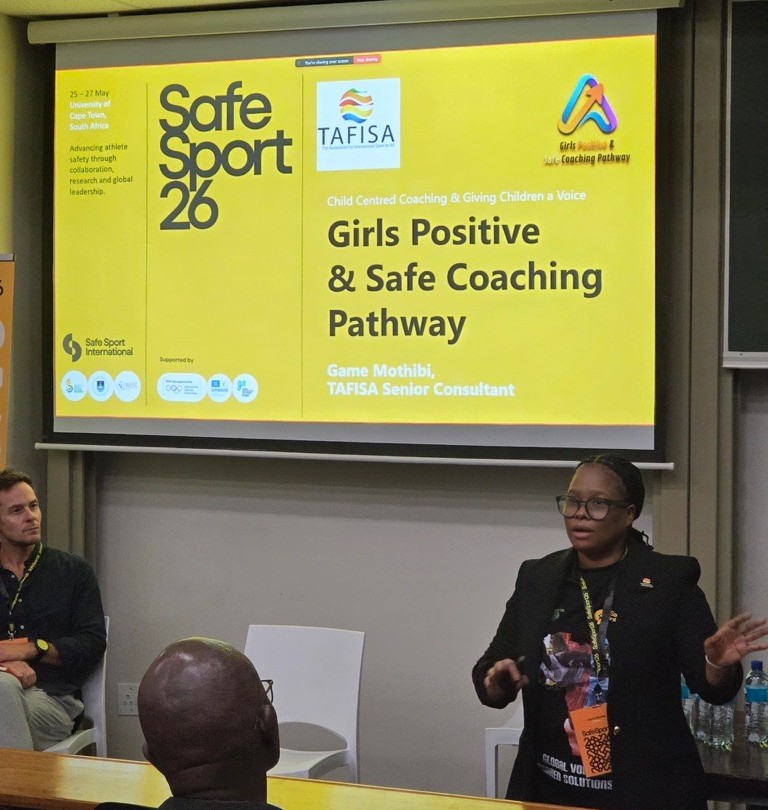
Game Mothibi, TAFISA Senior Consultant, joined the 3 day Safe Sport Global Conference 2026 in Cape Town, South Africa as a panellist in the session on Child-Centered Coaching & Giving Children a Voice.
The Safe Sport International Conference is one of the most important gatherings in global sport, bringing together leaders, practitioners, and advocates committed to making sport safe, inclusive, and empowering for every child. The 2026 edition, held in Cape Town, South Africa, convened under the theme "Advancing Athlete Safety Through Collaboration, Research and Innovative Leadership", a call to move beyond good intentions and into collective, evidence-based action.
It was in that spirit that TAFISA Senior Consultant Game Mothibi took to the panel stage on day 2 of the conference, joining fellow speakers in a session dedicated to Child-Centered Coaching & Giving Children a Voice, a topic that sits at the very heart of TAFISA's Girls Positive and Safe Coaching Pathway programme.
The session asked a fundamental question: "What does it really mean to give children a voice in sport?" For TAFISA, the answer is not theoretical. It is built into the design of the Girls Positive & Safe Coaching Pathway , a programme that has reached over 40,000 girls across four regions and continues to grow, supported by a network of 71 trainers operating across more than 60 countries.
What makes the Pathway distinctive is its origin and its honesty. When the programme launched, the target was women coaches. But on the ground, the reality was different, there were fewer female coaches than anticipated. Rather than retreat, the programme adapted, bringing male coaches in as deliberate allies in girls' journeys. Today, men are not peripheral to the Pathway, they are central to it, positioned not as gatekeepers but as advocates and supporters of girls' right to sport.
Equally important is the programme's commitment to cultural relevance. Every module is designed to bring cultural context into the room, recognising that safeguarding and gender equality cannot be delivered through a one-size-fits-all approach. Integrating policy into national existing structures, and ensuring that approach is locally owned, is what makes safe sporting environments sustainable.
Game also underscored that girls in this programme are not simply beneficiaries, they are core designers. The Pathway trains trainers, who in turn train coaches to listen first and instruct second, to design programmes with girls rather than for them, and to create environments where a child's voice doesn't just get heard, but actually shapes decisions. With 2,267 coaches trained, 62 of them retired athletes transitioned into coaching roles and partners across Africa, the Caribbean, Europe and the Pacific, the programme is proving that when you invest in the coach as a safe-space creator, children thrive.
The session was a reminder that child-centered coaching is not a soft ideal. It is a data-driven, structurally embedded, culturally informed commitment.
TAFISA remains committed to a world where every child regardless of gender, geography, or background has the right to sport, the right to play, and the right to be heard.